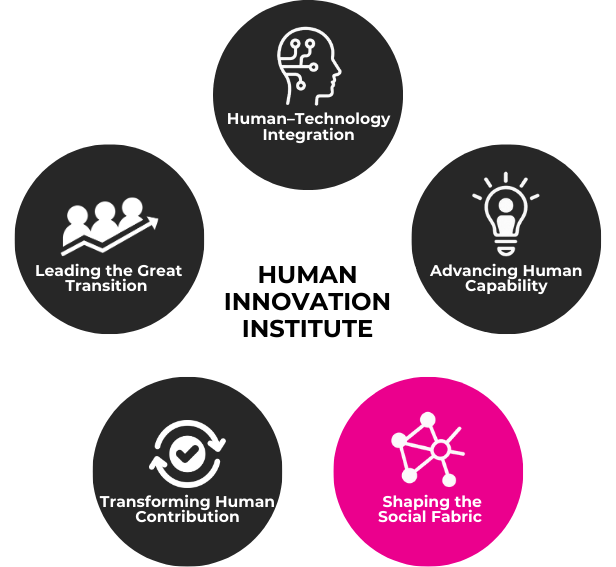
SHAPING THE SOCIAL FABRIC
What is it
Shaping the Social Fabric explores how shared meaning, trust, and coordination are formed in fragmented social environments. It focuses on how humans relate, belong, and make sense together during fragmentation and division.
Why is it important
Breakdowns in shared reality undermine cooperation, legitimacy, and collective action. Without new ways to rebuild coherence and trust, societies risk sliding into fragmentation without the capacity to respond collectively.
Where We Work
The Frontier Domains of this theme examine where social cohesion is under strain. They focus on the forces disrupting shared understanding, belonging, and coordination. These domains identify the conditions under which new forms of sensemaking and social trust must be rebuilt. They mark the front lines of social coherence during The Great Transition.
FRONTIER DOMAINS

FOSTERING SHARED CULTURE
How we strengthen and build a shared culture that benefits all members of society.

BUILDING TRUST DURING TRANSITION
How we develop sustainable sources of trust that are stable in volatile times.
STEWARDING COLLECTIVE DIRECTION
How we activate and advance mutually beneficial outcomes with groups of people.
LAB EVENT SERIES:
Shaping the Social Fabric
45-Minute Thematic Lab (Working Session)
Overview
The Shaping the Social Fabric working session is a 45-minute facilitated session hosted by the Human Innovation Institute designed to help participants examine and strengthen the social fabric they are personally embedded in during the Great Transition.
One of the defining features of this moment is the erosion of a shared reality and a common culture. Inherited social structures that once supported trust, belonging, and coordination are weakening. Information environments fragment understanding. Institutional legitimacy is unstable. As a result, social coherence can no longer be assumed at any level, from families and teams to communities, organizations, and broader society.
This working session introduces Shaping the Social Fabric as a live pressure zone where . Participants face trust, or cultural erosion. This could include their work environment, family system, community, organization, or a broader social or civic context. The session focuses on understanding how shared culture, trust, and direction are currently forming or breaking down within that fabric, and what role the participant is playing within it.
Participants are guided through a structured working process that helps them clarify where fragmentation or strain is present, how coherence is currently being supported or undermined, and where they can act with greater intention. The emphasis is not on fixing systems or controlling outcomes, but on understanding one’s role and responsibility in shaping healthier patterns of connection, coordination, and trust.
This is an active working session designed to help participants gain clarity on how they show up within the social environments they inhabit and how they might contribute more constructively within them.
Session Outputs
By the end of the 45-minute working session, participants can expect to leave with:
A clarified snapshot of the social environments they participate in, including key fragmentation, trust, or coordination pressure points
Tools and frameworks to create an initial articulation of how shared culture is being formed or distorted in their current contexts
Greater clarity on how collective direction can be stewarded without reliance on centralized authority or forced alignment
Recap of the working session
Lab ThinkSheet(s)
Research report on the specific theme
90 Day Project work plan template to continue work individually
Exclusive invites to future HII programs