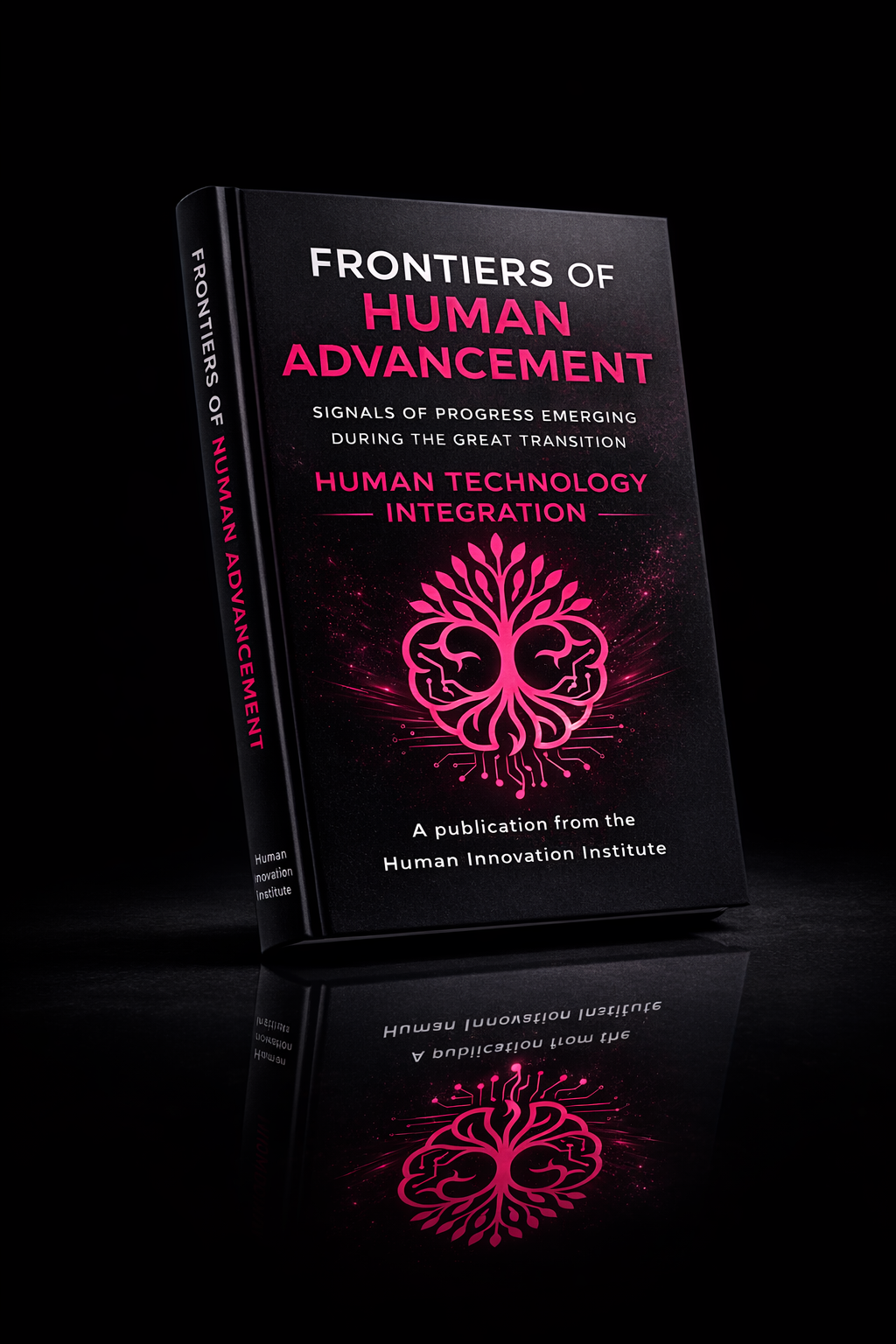
Frontiers of Human Advancement:
Human-Technlogy Integration
Human-technology integration has become one of the defining frontiers of the Great Transition because the relationship between humans and machines is no longer limited to simple assistance. We are entering a period in which technology increasingly participates in cognition, judgment, creativity, and decision-making, forcing a deeper reappraisal of what it means to remain capable, intentional, and human in an AI-mediated world. At the center of this e-publication is a pressing question: how consciously and responsibly will we design our relationship with technology as its role in daily life and work continues to expand?
The e-publication explores this frontier through three interrelated domains. The first, Forging Human-Technology Relationships, examines the quality of the partnership itself, asking how trust, authorship, oversight, and creative collaboration are being reshaped as AI becomes a more active participant in human thought and action. The second, Cultivating Human Autonomy With Technology, turns to the conditions required for self-direction in digitally saturated environments, arguing that autonomy must now be deliberately cultivated as a core human capability through aligned habits, education, institutional design, platform accountability, and governance.
The third domain, Harnessing Technological Acceleration, addresses the widening gap between the speed of technological development and the slower pace of human and institutional adaptation. It explores how individuals, organizations, and societies can build the capabilities needed to interpret signals, integrate change, manage cognitive load, and respond to acceleration without losing direction or humanity. Taken together, these three domains make the case that human-technology integration is not merely a technical or skills challenge, but a developmental, organizational, and civilizational one that will help determine the future of human agency, capability, and collective life.