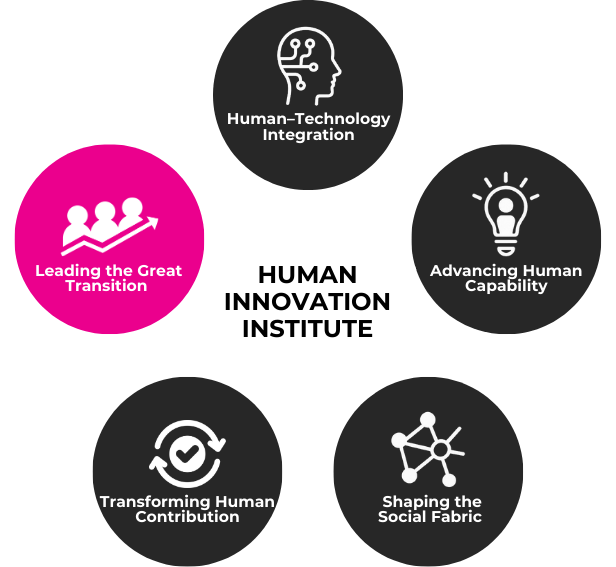
LEADING THE GREAT TRANSITION
What is it
Leading the Great Transition addresses how humans exercise judgment and responsibility in shaping emerging systems. It focuses on leadership when authority is decentralized and outcomes are uncertain.
Why is it important
As inherited institutions lose legitimacy, humans are increasingly required to decide and design without reliable maps. The absence of clear authority raises the stakes of judgment, responsibility, and long-term impact.
Where We Work
The Frontier Domains of this theme surface the environments where leadership is no longer assigned or clear. They explore how direction, legitimacy, and stewardship are practiced during transition and transformation. These domains make visible where humans must act without control or guarantees. They frame leadership as an active responsibility rather than a formal role.
FRONTIER DOMAINS

FORMING DIRECTION AND VISION DURING UNCERTAINTY
How we formulate, set, and align on where we need to go and how best to get there when conditions are uncertain and challenging.
STRATEGICALLY NAVIGATING RAPID AND COMPLEX CHANGE
How we adapt and respond to accelerated complexity and change
GUIDING SOCIETAL AND ORGANIZATIONAL TRANSFORMATION
How we lead change in order to ensure transformation takes place
LAB EVENT SERIES:
Leading the Great Transition
45-Minute Thematic Lab (Working Session)
Overview
The Leading the Great Transition Lab is a 45-minute working session hosted by the Human Innovation Institute designed to help participants examine what it means to effectively lead in environments defined by uncertainty, decentralization, and long-horizon consequences.
Organizations increasingly lack the bench depth to fill top leadership positions with their organizations, including C-suite roles. Caretaker leaders with operational depth is an insufficient profile for leading during transitional and volatile periods. They are increasingly participating in the design of the systems, institutions, and environments that shape human development, behavior, and markets. In this context, the ability to adapt to constant change, iterate real-time, and evolve rapidly are the most critical capabilities.
This working session introduces 'Leading the Great Transition' as a pressure zone where leadership is being redefined real time. Evolving beyond positional authority, predefined strategies, or five-year plans, the session focuses on increasing agency, practicing adaptability, and building resilience. It's organized around how leaders form an orientation amid uncertainty, how outcomes are produced when performance is distributed and delayed, and how transformation is guided when authority is constantly evolving.
Participants are guided through a working session that helps them examine how they currently interpret complexity, make decisions, and intervene in systems they influence. The focus is on clarifying how leadership is exercised today, where responsibility is being avoided or overextended, and how a more coherent and legitimate leadership stance can be developed.
This is an active working session designed to help participants clarify how they lead, how they shape environments, and how they hold responsibility in environments where certainty and control are no longer available.
Session Outputs
By the end of the 45-minute working session, participants can expect to leave with:
A snapshot of the current leadership context, including key uncertainty, legitimacy, and responsibility pressure points
Greater clarity on how perspective is formed and decisions are made amid complexity and incomplete information
Tools and frameworks to create an initial articulation of what responsible impact looks like in the systems and environments they influence
Recap of the working session
Lab ThinkSheet
Research report on the specific theme
90 Day Project work plan template to continue work individually
Exclusive invites to future HII programs